
⚠️ Important Disclaimer: This content is for educational and informational purposes only and does not constitute financial, tax, or legal advice. Tax laws are complex and subject to change. Always consult with a qualified tax advisor or accountant regarding your specific circumstances before making any tax-related decisions.
If you're managing tax obligations across multiple countries and have ever used an online tax calculator, there's a good chance you've had a nagging feeling: "This feels too clean."
The numbers are precise. The interface is sleek. And yet, something about it doesn't sit right.
That discomfort isn't because you don't understand multi-jurisdiction taxation. It's because your intuition is picking up on something the software is missing. Most tax calculators weren't built for the way you actually live as a cross-border professional. They were built for a world that stays within its own borders.
For global professionals navigating multi-country tax residency and cross-border tax obligations, those rules simply don't apply.
The Three-Country Problem: When Your Life Doesn't Fit in One Box
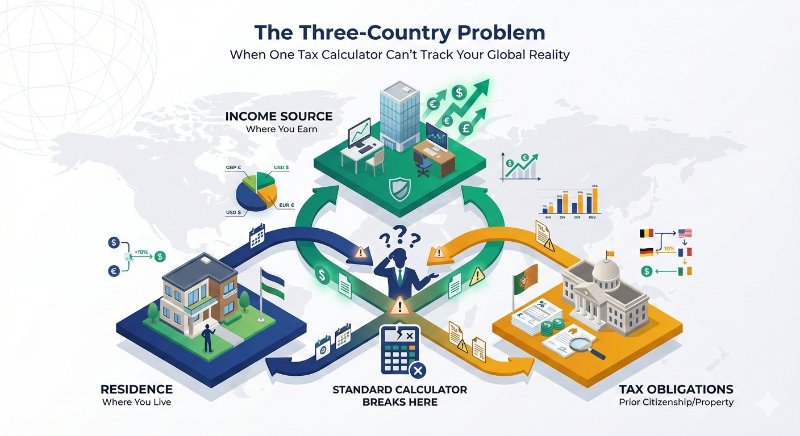
Here's the reality for a growing number of professionals in 2026: You earn income in one country, you live in another, and you have tax obligations in a third.
Maybe you're a consultant who works for US clients, lives in Portugal, but kept UK citizenship and property. Or you're employed by a German company, relocated to Dubai, but your family stayed in Berlin. Or you're a digital nomad earning in multiple currencies while your "home" country still considers you a tax resident.
This is what we call the Three-Country Problem in multi-jurisdiction taxation. And it's where every standard tax calculator breaks.
The Problem: Four Assumptions That Fall Apart at the Border
For someone who lives, earns, and invests in a single country, tax calculators are genuinely helpful. They take a complex system and turn it into a reasonable estimate.
The issue is that they assume a very specific kind of life. When you're dealing with multi-jurisdiction taxation, they rely on four major assumptions that fail the moment you cross a border:
- One jurisdiction determines your tax rules.
- One currency underpins every transaction.
- One tax year (usually January to December) tells the whole story.
- One status (Resident) applies to you at all times.
Once your life spans multiple jurisdictions, these assumptions don't just become slightly off. They break entirely. This is the core challenge of cross-border taxation that standard calculators simply can't handle.
What Happens When the Calculator Gets It Wrong
During our recent Market Research and Product Discovery phase, we surveyed global professionals navigating the massive shifts in multi-jurisdiction taxation over the last 12 months. The data showed a significant gap between what "calculators" say and what "tax offices" actually do when you're managing obligations across multiple countries.
The consequences aren't just annoying. They're expensive.
The "Only Home" Trap
Consider a professional who moved from London to Switzerland in early 2026. They carefully stayed under the 183-day limit and assumed they were non-resident from the day they landed.
However, they kept their London flat available while searching for a home in Zurich. Because they had a home in the UK for more than 91 days and spent at least 30 days there, they met the "Only Home" test under the Statutory Residence Test (SRT).
A standard tax calculator would have labeled them a non-resident. HMRC labeled them a full resident, meaning their global income was suddenly back in the UK tax net.
The calculator only counted days. HMRC counted ties.
This is exactly the type of multi-jurisdiction tax complexity that automated tools miss. Depending on income levels, this type of miscalculation could result in unexpected tax bills ranging from £20,000 to £50,000 or more, plus potential penalties for underpayment.
The Digital Nomad Mistake
A consultant living in Romania on a Digital Nomad Visa assumed their income was tax-free because of the visa's 183-day rule. But because their spouse and children remained in Germany, German authorities argued their "Center of Vital Interests" remained at home.
They were hit with back-taxes because their tracking tool only looked at "days in the country," ignoring the family ties that multi-jurisdiction tax treaties actually prioritize.
Their calculator passed the simple test: fewer than 183 days in Germany. But the German tax office applied a different test entirely, one based on where their life actually centered, not just where they physically stood.
Why This Matters More in 2026
In 2026, the old UK "Non-Dom" rules are gone. They've been replaced by the Foreign Income and Gains (FIG) regime. This new system for cross-border taxation is based purely on residence, not domicile. While it offers a 4-year tax holiday for new arrivals, it's a binary switch.
If you trip a multi-jurisdiction tax residency test too early, you lose the relief entirely. There's no partial benefit. There's no "close enough."
And your calculator? It has no idea this regime even exists. It's still calculating based on rules from 2024.
Note: If you have pre-April 2025 foreign income and are affected by these changes, be aware that the UK's Temporary Repatriation Facility (TRF) is currently available with specific rates and deadlines. Given the complexity of this regime and its time-sensitive nature, professional tax advice is essential to understand how it may apply to your situation.
The Double Taxation Trap Your Calculator Ignores
Another reason tax calculators struggle with multi-jurisdiction taxation is the difference between tax deducted and tax owed. If you have US-source income while living abroad, you might see a 30% withholding tax deducted automatically. It's tempting to plug that into a calculator as "tax paid" and move on.
In reality, that 30% is often just a starting point when dealing with cross-border tax obligations.
Many professionals with cross-border investment portfolios miss opportunities to claim relief under Double Taxation Agreements (DTAs). While withholding tax might be deducted at 30%, treaty rates between many countries reduce this to 15% or less. However, these benefits aren't automatic- they must be actively claimed.
Standard calculators typically treat withholding as final tax, missing these treaty opportunities entirely. Understanding tax treaty benefits is crucial for effective multi-jurisdiction tax planning, but requires specialized knowledge of which treaties apply to your specific situation.
What You're Actually Feeling
That nagging feeling when you look at your tax calculator's results? It's not imposter syndrome. It's not because you lack expertise. It's your brain picking up on complexity that the software was never designed to handle.
The calculator is giving you an answer. But it's answering a different question than the one your tax office will ask.
It's answering: "What would your taxes be if you lived a simple, single-country life?"
Your tax office is asking: "Where are your ties? When did you move? Which treaties apply? What's your vital interest?"
These are fundamentally different questions. And the gap between them can be significant.
What Comes Next
The problem isn't you. The problem is that your life has outgrown the tools designed for it.
So what do you do? How do you know if your numbers are even close to accurate?
We've created a framework to help you evaluate any tax calculator before you trust its results. You'll learn what questions the calculator should be asking → (but probably isn't), and what red flags mean your estimate might be dangerously wrong.
Because the first step to solving a problem is knowing you have one.
The second step is knowing how to spot when someone else is missing it too.
Disclaimer: The information provided in this article is for general educational purposes only and should not be construed as tax, legal, or financial advice. Tax laws and regulations are complex, vary by jurisdiction, and are subject to change. The examples provided are hypothetical and for illustrative purposes only. Individual circumstances vary significantly, and what applies to one person may not apply to another. We strongly recommend consulting with qualified tax professionals, accountants, or legal advisors who are familiar with the specific tax laws and treaties relevant to your situation before making any decisions or taking any actions based on this information.
Related Topics: Multi-jurisdiction tax planning, cross-border taxation for individuals, Three-Country Problem, tax calculator accuracy, multi-country tax residency, expat tax mistakes
Tags: #MultiJurisdictionTax #CrossBorderTax #ThreeCountryProblem #TaxCalculator #ExpatTax #UKTax #FIGRegime